Visualizing Compressed Latents

HTML
Diffusion
Analyzing Models
Creating an app to visualize the latents produced by an autoencoder.
Author

Salman Naqvi

Published

Friday, 17 April 2026

Thanks to Jonothan Whitaker’s VAE implementation in lesson 9a of the fastai course.

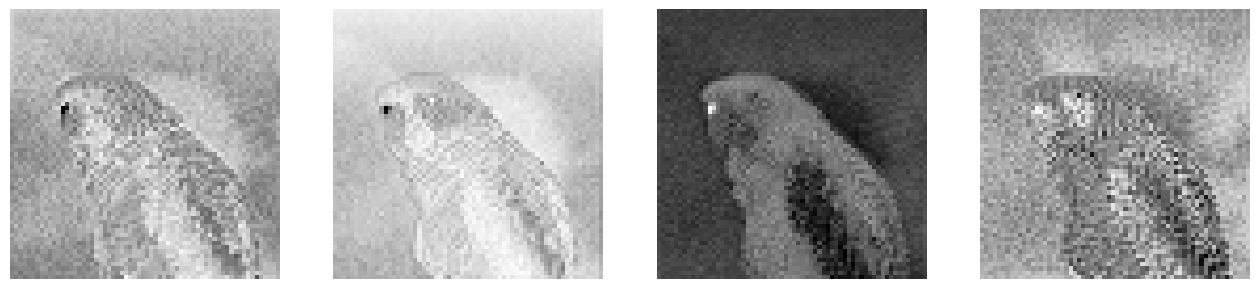
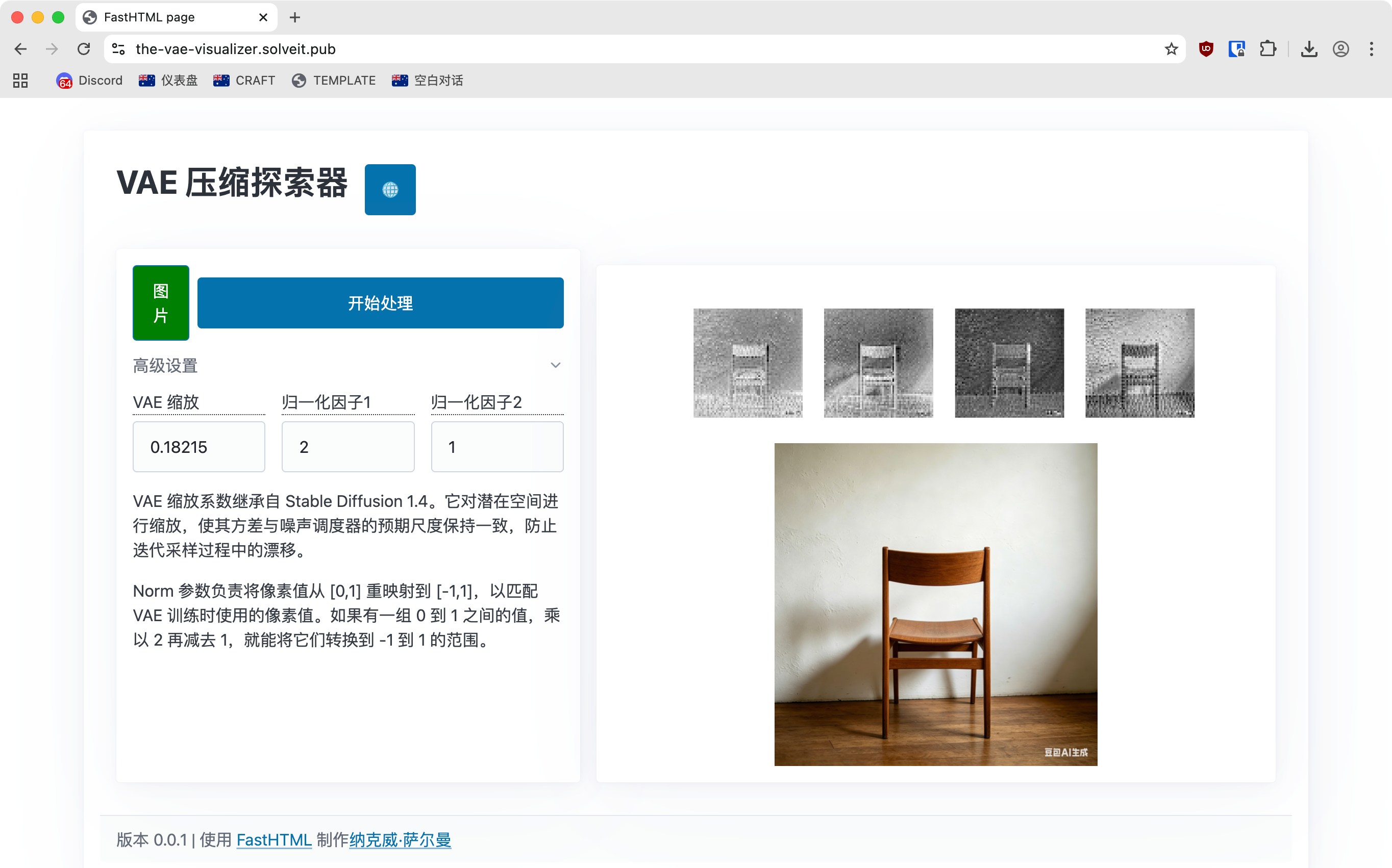
This notebook is the source code for a VAE visualization app I created that allows you to see how the compressed latents look like, and tweak certain parameters that produce the latents. You can explore the app here. Works best with images whose dimensions are multiples of 8.

Explore the VAE

from diffusers import AutoencoderKL
vae = AutoencoderKL.from_pretrained("CompVis/stable-diffusion-v1-4", subfolder="vae")
/usr/local/lib/python3.12/site-packages/huggingface_hub/utils/_validators.py:205: UserWarning: The `local_dir_use_symlinks` argument is deprecated and ignored in `hf_hub_download`. Downloading to a local directory does not use symlinks anymore.
  warnings.warn(
Warning: You are sending unauthenticated requests to the HF Hub. Please set a HF_TOKEN to enable higher rate limits and faster downloads.
!curl --output macaw.jpg 'https://lafeber.com/pet-birds/wp-content/uploads/2018/06/Scarlet-Macaw-2.jpg'
  % Total    % Received % Xferd  Average Speed   Time    Time     Time  Current
                                 Dload  Upload   Total   Spent    Left  Speed

  0     0    0     0    0     0      0      0 --:--:-- --:--:-- --:--:--     0
100 58602  100 58602    0     0  1014k      0 --:--:-- --:--:-- --:--:-- 1021k
from PIL import Image
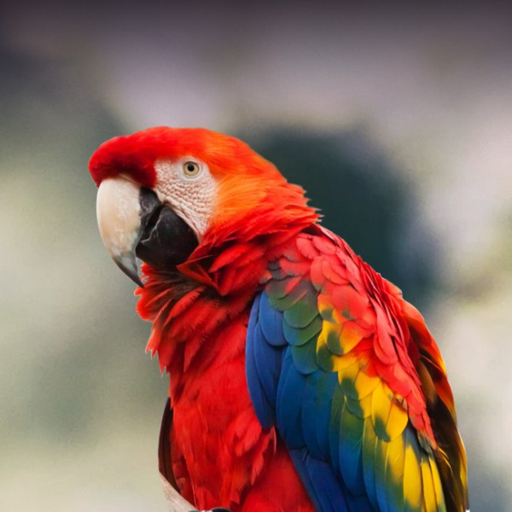
img = Image.open('macaw.jpg').resize((512,512)); img

The image needs to be converted to a PyTorch tensor.

import torch
from torchvision.transforms import v2
v2.Compose([v2.ToImage(), v2.ToDtype(torch.float32, scale=True)])(img)
Image([[[0.1804, 0.1804, 0.1804,  ..., 0.2392, 0.2392, 0.2431],
        [0.1843, 0.1843, 0.1843,  ..., 0.2392, 0.2392, 0.2431],
        [0.1843, 0.1882, 0.1882,  ..., 0.2431, 0.2431, 0.2431],
        ...,
        [0.8471, 0.8471, 0.8471,  ..., 0.5373, 0.5490, 0.5686],
        [0.8471, 0.8471, 0.8471,  ..., 0.5333, 0.5451, 0.5608],
        [0.8471, 0.8471, 0.8471,  ..., 0.5294, 0.5451, 0.5569]],

       [[0.1529, 0.1529, 0.1529,  ..., 0.2118, 0.2118, 0.2157],
        [0.1569, 0.1569, 0.1569,  ..., 0.2118, 0.2118, 0.2157],
        [0.1569, 0.1608, 0.1608,  ..., 0.2157, 0.2157, 0.2157],
        ...,
        [0.8196, 0.8196, 0.8196,  ..., 0.5569, 0.5647, 0.5843],
        [0.8196, 0.8196, 0.8196,  ..., 0.5569, 0.5647, 0.5765],
        [0.8196, 0.8196, 0.8196,  ..., 0.5529, 0.5608, 0.5725]],

       [[0.1843, 0.1843, 0.1843,  ..., 0.2431, 0.2431, 0.2471],
        [0.1882, 0.1882, 0.1882,  ..., 0.2431, 0.2431, 0.2471],
        [0.1882, 0.1922, 0.1922,  ..., 0.2471, 0.2471, 0.2471],
        ...,
        [0.7098, 0.7098, 0.7216,  ..., 0.5569, 0.5686, 0.5882],
        [0.7098, 0.7098, 0.7216,  ..., 0.5569, 0.5647, 0.5804],
        [0.7098, 0.7098, 0.7216,  ..., 0.5529, 0.5647, 0.5765]]], )
ToTensor = v2.Compose([v2.ToImage(), v2.ToDtype(torch.float32, scale=True)]); ToTensor
Compose(
      ToImage()
      ToDtype(scale=True)
)
ToTensor(img).shape, ToTensor(img)[None,...].shape
(torch.Size([3, 512, 512]), torch.Size([1, 3, 512, 512]))

v2.ToDtype needs to be usedd. Otherwise directly using v2.ToImage results in a uint8 tensor

import torch
from torchvision.transforms import v2
with torch.no_grad():
    lat = vae.encode(ToTensor(img)[None,...]*2-1)
    lat = 0.18215 * lat.latent_dist.sample()
lat.shape, lat[0].shape
(torch.Size([1, 4, 64, 64]), torch.Size([4, 64, 64]))
import matplotlib.pyplot as plt
fig,axs = plt.subplots(1,4, figsize=(16,4))
for c in range(4): 
    axs[c].imshow(lat[0][c], cmap='Greys')
    axs[c].axis('off')

APP

The app will be written with FastHTML. I will be previewing the app inline within this dialog. For this to work, I first tweak a Starlette setting so cookies also work within the inline previews.

from starlette.middleware.sessions import SessionMiddleware

class PartitionedSessionMiddleware(SessionMiddleware):
    def __init__(self, *args, **kwargs):
        super().__init__(*args, **kwargs)
        self.security_flags += "; partitioned"

Now I define the app.

from fasthtml.common import *

app = FastHTML(hdrs=(picolink, MarkdownJS(), HighlightJS()), debug=True, session_cookie='vae_app', same_site='none', sess_https_only=True, sess_cls=PartitionedSessionMiddleware)
rt = app.route

Now I write the code that will allow me to preview the app inline.

from functools import partial
from fasthtml.jupyter import *

port = 8002
url = 'the-vae-visualizer.solveit.pub'
server = JupyUvi(app, port=port)
def get_preview(app): return partial(HTMX, app=app, host=url, port=443)
prev = get_preview(app); prev()
def p(component):
    if hasattr(component, 'app'): return prev(component)
    else:
        @rt
        def _test(): return component
        return prev(_test)
p(Input())
render_ft()

render_ft enables rendering of HTML components inline.

Localization

from contextvars import ContextVar
current_lang = ContextVar('lang', default='zh'); current_lang
<ContextVar name='lang' default='zh' at 0x75bbc4baab10>

When a user accesses this application, ContextVar will give each request its own independent copy of a variable. In this way, different values of current_lang can be kept on the same instance.

@rt
def setsession(session):
    current_lang.set(session.setdefault('lang', 'zh'))
T = {
    'zh': {
        'title': 'VAE 压缩探索器',
        'process': '开始处理',
        'advanced_settings': '高级设置',
        'image_label': '图片',
        'vae_scale_label': 'VAE 缩放',
        'vae_scale_tip': '归一化潜在空间,匹配噪声调度器的尺度',
        'norm_one_label': '归一化因子1',
        'norm_two_label': '归一化因子2',
        'norm_tip': '将像素值从 [0,1] 映射到 [-1,1],匹配 VAE 训练分布',
        'no_result': '这里还空着呢~',
        'error_msg': '❌ 错误:',
        'vae_scale_desc': 'VAE 缩放系数继承自 Stable Diffusion 1.4。它对潜在空间进行缩放,使其方差与噪声调度器的预期尺度保持一致,防止迭代采样过程中的漂移。',
        'norm_desc': 'Norm 参数负责将像素值从 [0,1] 重映射到 [-1,1],以匹配 VAE 训练时使用的像素值。如果有一组 0 到 1 之间的值,乘以 2 再减去 1,就能将它们转换到 -1 到 1 的范围。',
        'footer': '版本 0.0.1 | 使用 ',
        'crafted_by': ' 制作',
        'name': '纳克威·萨尔曼'
    },
    'en': {
        'title': 'VAE Compression Explorer',
        'process': 'Process',
        'advanced_settings': 'Advanced Settings',
        'image_label': 'Image',
        'vae_scale_label': 'VAE Scale',
        'vae_scale_tip': "Normalizes latent variance to align with the noise scheduler's scale",
        'norm_one_label': 'Norm 1',
        'norm_two_label': 'Norm 2',
        'norm_tip': 'Rescales pixel values from [0,1] to [-1,1] to match VAE training distribution',
        'no_result': 'Nothing here yet!',
        'error_msg': '❌ Error: ',
        'vae_scale_desc': 'The VAE Scale is a variance normalization constant inherited from Stable Diffusion 1.4. It scales the latent so its variance is consistent with the noise scheduler\'s expected scale. This prevents drift during the iterative sampling process.',
        'norm_desc': 'The "Norm" parameters are responsible for remapping pixel values from [0,1] to [-1,1], matching the pixel values the VAE was trained on. If we have a set of values betweeen 0 and 1, multiply them by 2, and then subtract one, we\'ve transformed that set of values to be between -1 and 1.',
        'footer': 'Version 0.0.1 | Crafted with ',
        'crafted_by': ' by ',
        'name': 'Salman Naqvi'
    }
}
def t(key, session=None):
    lang = session.get('lang', 'zh') if session else current_lang.get()
    return T[lang].get(key, key)
t('title')
'VAE 压缩探索器'

VAE Compression

def img2lat(img, scale, nconst1, nconst2):
    with torch.no_grad():
        lat = vae.encode(ToTensor(img)[None, ...]*nconst1-nconst2)
        return scale * lat.latent_dist.sample()

def lat2img(lat, scale, nconst1, nconst2):
    lat *= 1/scale
    with torch.no_grad(): img = vae.decode(lat).sample
    img = ((img+nconst2)/nconst1).clamp(0,1)
    img = img.detach().permute(0,2,3,1).numpy()
    return Image.fromarray((img*255).round().astype('uint8')[0])

def lat2plot(lat):
    fig,axs = plt.subplots(1,4, figsize=(16,4))
    for c in range(4):
        axs[c].imshow(lat[0][c], cmap='Greys')
        axs[c].axis('off')
    return fig
from io import BytesIO
from base64 import b64encode
def process(fbytes, scale=0.18215, nconst1=2, nconst2=1):
    oimg = Image.open(BytesIO(fbytes)).resize((512,512))
    lat = img2lat(oimg, scale, nconst1, nconst2)
    fig = lat2plot(lat)
    # pimg = lat2img(lat, scale, nconst1, nconst2)
        
    buf1, buf2 = BytesIO(), BytesIO()
    fig .savefig(buf1, format='png')
    # pimg.save   (buf2, format='png')
    oimg.save   (buf2, format='png')
    
    def buf2b64(buf): buf.seek(0); return b64encode(buf.read()).decode()
    return mapt(buf2b64, [buf1,buf2])

I use BytesIO to avoid having to save the image to disk. process returns a base64 representation so the image can be directly rendered in the browser.

buf = BytesIO()
img.save(buf, format='png')
buf.seek(0)
a, b = process(fbytes=buf.getvalue())

a[:200], b[:200]
('iVBORw0KGgoAAAANSUhEUgAABkAAAAGQCAYAAAD2lawGAAAAOnRFWHRTb2Z0d2FyZQBNYXRwbG90bGliIHZlcnNpb24zLjEwLjgsIGh0dHBzOi8vbWF0cGxvdGxpYi5vcmcvwVt1zgAAAAlwSFlzAAAPYQAAD2EBqD+naQAAsqJJREFUeJztvXvwntdZnvuEHjgUEmM7',
 'iVBORw0KGgoAAAANSUhEUgAAAgAAAAIACAIAAAB7GkOtAAEAAElEQVR4nKz9Sbdlu44uhn0f5toRcc65WTy9J0vDsp6b6tn//6e442F37DGeLOWtThGxFwE3QIBgMdfeN1Mz88ZZe04WIIiKIAjy//a//N8BACBJEuVZ3uTvpVi+MbO9lpmJiKrW6lkS98/Staqamb9c')

Upload Route

from base64 import b64encode
from io import BytesIO
from PIL import Image
@rt
async def upload(file:UploadFile, vae_scale:float, norm_one:float, norm_two:float): 
    try:
        fbytes = await file.read()
        lat_b64, proc_b64 = process(fbytes, vae_scale, norm_one, norm_two)
        return Div(style="display:flex; flex-direction:column")(
            Img(src=f'data:image/jpeg;base64,{lat_b64}', style='max-width:800px; width: 100%'),
            Img(src=f'data:image/jpeg;base64,{proc_b64}', style='max-width:800px; width: 50%; display:block; margin:auto'),
        )
    except Exception as e: return Article(f"{t('error_msg')}{e}", style="color: var(--pico-del-color); border-color: var(--pico-del-color);")
from starlette.datastructures import UploadFile
buf.seek(0)
uf = UploadFile(file=buf); uf
UploadFile(filename=None, size=None, headers=Headers({}))
# 
# await upload(uf, 0.18215, 2, 1)

Dashboard

import fasthtml.components as fc
@delegates(fc.Input)
def LabelledInput(lbl=None, tip=None, id=None, name=None, **kwargs): 
    assert id is not None or name is not None, "id or name required"
    return Div(style='flex-direction:column')(
        fc.Label(lbl, data_tooltip=tip, fr=f'inp-{id or name}', id=f'lbl-{id or name}'), 
        fc.Input(id=f'inp-{id or name}', name=name, **kwargs)
    )

I’ve overwritten Input so it always has a Label component attached to it.

p(LabelledInput(placeholder='hehe', name='testing', tip='LOL', lbl='haha'))
def Dashboard():
    return Card(style='flex:2')(
        Form(hx_post=upload, hx_target='#res', hx_swap='innerHTML',
             hx_indicator='#loading', hx_disabled_elt='#process-btn, #upload-inp',
             enctype="multipart/form-data")(
            UploadWidget(),
            Div(style='margin-top: 1rem')(SettingsWidget()),
        )
    )
def UploadWidget():
    return Div(style='display:flex; align-items:center; gap:0.5rem')(
        UploadInput(t('image_label'), name='file'),
        Button(t('process'), type='submit', id='process-btn', style='margin-bottom:0;'),
    )
@delegates(fc.Input)
def UploadInput(lbl=None, id=None, name=None, **kwargs): 
    assert id is not None or name is not None, "id or name required"
    return Div()(
        fc.Label(style='margin-bottom:0', role='button')(lbl, id=f"lbl-{id or name}", fr=f"inp-{id or name}"),
        fc.Input(id=f"inp-{id or name}", name=name, type='file', accept='image/*', style='display:none; margin-bottom:0', onchange="this.previousElementSibling.style.backgroundColor = this.files[0] ? 'green' : ''", **kwargs),
    )
p(UploadInput('test', id='test'))
p(UploadWidget())
def SettingsWidget():
    return Details(
        Summary(t('advanced_settings'), id='adv-summary'),
        Div(style='display:flex; gap:1rem;')(
            LabelledInput(type='number', name='vae_scale', value=0.18215, step='any',
                lbl=t('vae_scale_label'), tip=t('vae_scale_tip')),
            LabelledInput(type='number', name='norm_one', value=2,
                lbl=t('norm_one_label'), tip=t('norm_tip')),
            LabelledInput(type='number', name='norm_two', value=1,
                lbl=t('norm_two_label'), tip=t('norm_tip')),
        ),
        P(t('vae_scale_desc'), id='vae-scale-desc'),
        P(t('norm_desc'), id='norm-desc')
    )
p(SettingsWidget())
p(Dashboard())

Main

I’ll first define route that’ll toggle language, before writing the index page.

@rt
def toggle_lang(session):
    lang = 'en' if session.get('lang') == 'zh' else 'zh'
    current_lang.set(lang)
    session['lang'] = lang
    return (
        Button(t('process'), type='submit', id='process-btn', hx_swap_oob='true', style='margin-bottom:0'),
        H1(t('title'), id='title', hx_swap_oob='true'),
        Summary(t('advanced_settings'), id='adv-summary', hx_swap_oob='true'),
        Div(id='res', style='display:flex; align-items:center; justify-content:center; flex:1', hx_swap_oob='true')(t('no_result')),
        Label(t('image_label'), id='lbl-file', fr='inp-file', role='button', hx_swap_oob='true', style='margin-bottom:0'),
        Label(t('vae_scale_label'), id='lbl-vae_scale', fr='vae_scale', hx_swap_oob='true', data_tooltip=t('vae_scale_tip')),
        Label(t('norm_one_label'), id='lbl-norm_one', fr='norm_one', hx_swap_oob='true', data_tooltip=t('norm_tip')),
        Label(t('norm_two_label'), id='lbl-norm_two', fr='norm_two', hx_swap_oob='true', data_tooltip=t('norm_tip')),
        P(t('vae_scale_desc'), id='vae-scale-desc', hx_swap_oob='true'),
        P(t('norm_desc'), id='norm-desc', hx_swap_oob='true'),
        Footer(id='footer', hx_swap_oob='true', style='color: var(--pico-muted-color);')(t('footer'), A('FastHTML', href='https://fastht.ml'), t('crafted_by'), A(t('name'), href='https://forbo7.github.io/'))
    )
@rt
def index(session): 
    setsession(session)
    return Card(style="padding: 2rem; max-width: 1200px; margin: 2rem auto;")(
        Div(style="display:flex; align-items:center; gap:1rem; margin-bottom:2rem")(
            H1(t('title'), id='title'),
            Button('🌐', hx_post=toggle_lang, hx_swap='none'),
            Div(id='loading', aria_busy='true', cls='htmx-indicator')(''),
        ),
        Div(style="display:flex; gap:1rem; align-items:stretch")(
            Dashboard(),
            Card(style='flex:3; margin-top:1rem; display:flex; flex-direction:column; align-items:center; min-height: 200px;')(
                Div(id='res', style='display:flex; align-items:center; justify-content:center; flex:1')(t('no_result')),
            )
        ),
        Footer(id='footer', style='color: var(--pico-muted-color);')(t('footer'), A('FastHTML', href='https://fastht.ml'), t('crafted_by'), A(t('name'), href='https://forbo7.github.io/'))
    )

prev(index)

If you have any comments, questions, suggestions, feedback, criticisms, or corrections, please do post them down in the comment section below!

Back to top